Omnix Agent · Omniflex integration partner, United States
Who commissions your Omniflex system in the field?
We put your field alarms where you can act on them. From Edina, Minnesota, we mount Teleterm RTUs, land the wires, set annunciator windows and leave a panel your own technicians can trace.
Based
Edina, MN
Coverage
Plants & utilities, USA
Phone
+1-952-835-4420
Doing
RTUs, I/O, annunciators, SCADA
01 · Who we are
Omniflex integration, one family of hardware
We are a US integration partner for Omniflex remote monitoring, working out of Edina, Minnesota.
We put your field alarms where you can act on them
Omnix Agent is an Omniflex integration partner serving industrial sites across the USA from 4820 W 77th St, Edina, MN 55435. We focus on one thing: making Omniflex remote monitoring readable, wired, and maintainable in real plants.
Phone +1-952-835-4420 reaches people who do the commissioning themselves — not a call desk. When you describe a panel, the person on the line has stood in front of one, with the drawings open and the torque driver in hand.
Equipment we put into service
Omniflex- Teleterm RTUs — M3e (model C2363A-0)
- Remote monitoring
- Teleterm M3R2 (model C2363A-32) — 868 MHz radio and Ethernet
- Radio / Ethernet
- Teleterm S3G1 (model C2380C-11)
- Compact RTU
- Powerterm PTC PSU/Chgr (model C2194A)
- Cabinet power
- Omni16C alarm annunciator product C1480B
- Annunciation
02 · The work
What we do every week
The same set of tasks, repeated across sites until the work is routine and the panels look alike.
- 01Mount and power the RTU
- 02Land field wires, ferruled and labelled
- 03Configure I/O and scales
- 04Set annunciator windows
- 05Map points into SCADA
- 06Hand over docs and backups
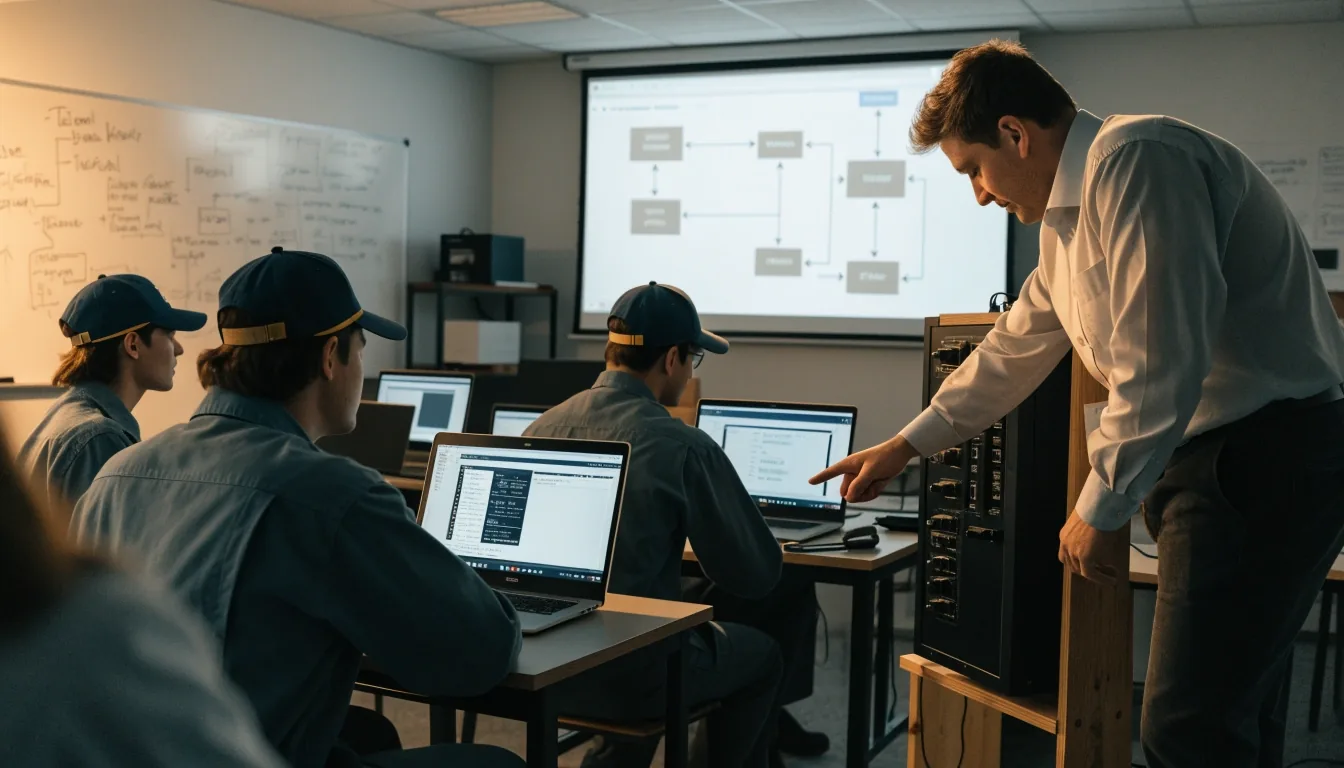
We mount Teleterm RTUs, land field wires, configure I/O, set annunciator windows, and map points into SCADA. The Teleterm family — M3e, M3R2 with its 868 MHz radio and Ethernet, and the compact S3G1 — covers most sites we see.
Power components such as the Powerterm PTC PSU/Chgr round out the cabinets. That weekly repetition is why the work stays consistent: the same ferrule sizes, the same point names, the same handover document at every site we leave.
03 · How we judge quality
A new technician should trace any alarm — window, wire, sensor
Terminations
Ferrule, flag, torque mark
Serial runs
RS232, RS422/485, isolated
Shielding
Drained at one end only
Backup
Config file, dated, on site
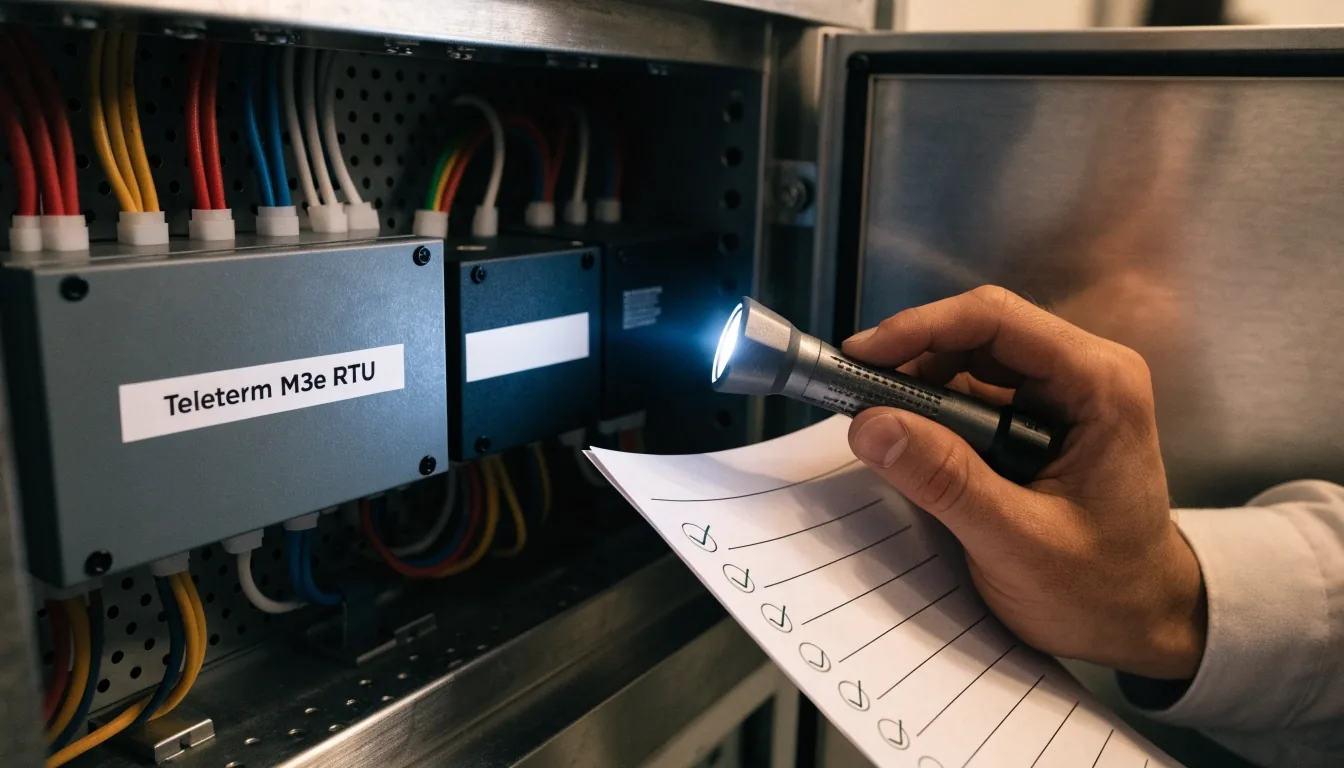
Experienced users look past brochures to terminals, labels and backups. That is how we judge a job: whether a new technician, on their own, can trace any alarm from window to wire to sensor without calling us.
Omni16C alarm annunciator product C1480B boards are laid out for that traceability — legend strip names the alarm, the lamp shows the state, and the terminal behind it belongs to the same name. Serial ports with full isolation, as described for Omni30 units with RS232/422/485, are wired with shield and ground done right: drained at one end, no stray loop left to wander into a comms fault on the first cold morning.
Clean cabinets photograph well because they service well. We would rather find a habit we can defend than a shortcut that only looks tidy.
04 · Getting started
A project starts with your drawings, your photos and your alarm list
Those three things, sent to the Edina office, are enough to open a conversation with real questions rather than a sales sheet.
Meet the practice-
01
You send what you have
Photos of the cabinet and the yard, as-built drawings if they exist, and your alarm list — the names you want to see on the annunciator windows.
-
02
We come back with questions
Power available at the panel, comms path — radio, leased line or Ethernet, and the SCADA addresses your master station already uses.
-
03
Site visit or remote survey
For a single cabinet, a short call and photos are often enough. For a first install at a site we have never seen, we walk the rack bay with you.
-
04
A scope you can read
Point counts, deliverables, responsibilities and a schedule. No vague phases, no consulting-speak in the middle of a document your operations lead has to sign.
-
05
Commissioning and handover
Small single-cabinet jobs move in weeks. Multi-site telemetry rollouts take longer and are scheduled in batches so travel time earns its place.
05 · Long-term value
The panel you inherit should still make sense in five years
Telemetry that only the installing engineer understands is a liability. Our rule is simple: the plant should be able to run its own monitoring without us, and should be able to add to it without re-doing the cabinet.
That is why we leave spare I/O, consistent wire colours, and configuration backups with dates. Documentation lives in the cabinet and in your inbox — not only in ours. When a technician opens the door two years from now, the drawing and the terminal should agree.
Gateway structures that combine monitor data into a single access path, as Omniflex describes for RPN1 with supported monitors including iCAM, keep future adds simple. When a new sensor arrives, the path it takes into your data is already there; the person adding it does not have to redesign the plant. Maintenance stays ordinary — and that is the point.

06 · Where we work
Edina, Minnesota — and wherever your site actually is
We serve plants and utilities across the USA. Much of our travel centres on the Upper Midwest, where a day trip is still realistic; scheduled trips farther afield cover multi-site rollouts and first-time start-ups.
- Remote support covers
- Configuration reviews, desktop view tuning
- On-site visits cover
- Wiring, cutover, handover
- Travel timing
- Agreed before work starts
07 · Limits we state plainly
We commission Omniflex monitoring and its direct interfaces
-
We do not manufacture sensors.
We wire, scale and test them; if a device needs replacement, we tell you the type and let you choose the vendor.
-
We do not provide utility power.
Cabinet power for the RTU and its peripherals is ours to plan; the feed upstream of the breaker is not.
-
We do not replace your SCADA host.
We map points into it and test them end to end. The master station and its licensing stay with your team.
-
Devices outside the supported-monitor scope get tested, not promised.
If a signal can be shared, we will wire it. If it cannot, we say so before the scope is signed.
When another trade is needed, we name it. Clear limits keep schedules honest.
08 · Why a single-family focus helps
Answering from memory, not from a manual opened on the day
Single-family focus means we know Teleterm I/O behaviour, annunciator sequences and SCADA mapping quirks without re-learning each job. A channel that reads low until you understand its reference, a Modbus register that shifts by one in a new firmware build, a legend strip that has to be re-punched when a plant renames a pump — those are the details that decide whether commissioning runs smoothly or drags into a second visit.
The trade press will tell you Omniflex hardware has a long service life; what it will not tell you is that a long service life is only useful when the next technician in the door can read the work. That is the part we take care of, and it is why the same crew keeps coming back to the panel.
Your operators get answers from people who have wired the same hardware before — telemetry, alarm annunciator panels, I/O and the SCADA side of the map. The panel you inherit becomes the panel you understand.
09 · Practical questions
The questions we are asked before a scope is written
If yours is not here, the same answers come out faster on the phone.
Do you come on site, or is this remote work?
Both. Wiring, cutover and handover are on-site work — someone has to land the ferrules and prove the loop. Configuration reviews, alarm list tidy-ups, and Data2Desktop or Omnergy view tuning can be handled remotely once the comms path is up.
We already have a cabinet. Can you pick up from where someone else stopped?
Yes, but we will spend time reading what is already there before we add to it. If the previous work has no labels and no backup, we say so in the scope and price the tidy-up honestly rather than quietly absorbing it.
What does a typical scope contain?
Point counts (digital in/out, analogue in/out), the RTU model and its power arrangement, the comms path, the alarm list as it will appear on the annunciator, the SCADA tags and their scale, and the handover pack — drawings, terminal schedule, and a dated configuration backup.
How long does commissioning take?
A single-cabinet turn-on usually moves in weeks from the first call, not months. Multi-site telemetry rollouts take longer because travel and cutovers have to be sequenced around your operations — we schedule those in batches rather than one site at a time.
What about Conlog remote monitoring equipment we already run?
Conlog remote monitoring units appear in the same yards we commission, so we know the practical overlap. If a site has one, we look at what it can share and where the boundary sits before we promise a merged view.
10 · Contact path
Write or call to start a review
A person answers during business hours and replies to messages in turn. Bring your point list and we will bring practical questions.
- Address
- 4820 W 77th St, Edina, MN 55435, United States
- Phone
- +1-952-835-4420
- Message desk
- info@omnix-agent.com
- Hours
- Monday to Friday, 9:00 AM – 6:00 PM